

Introduction
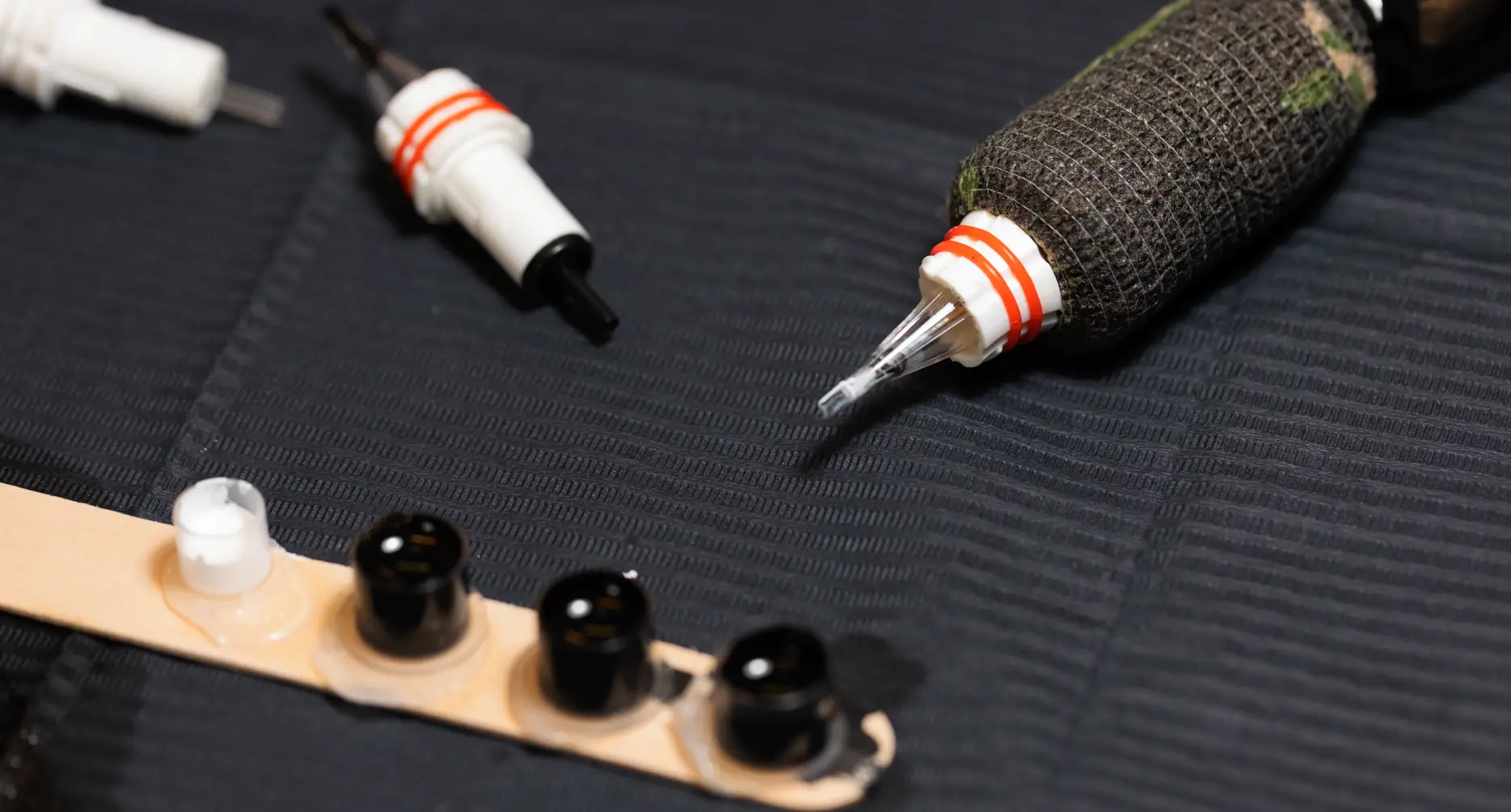
Choosing the right needle cartridge is one of the most consequential decisions a tattoo artist makes before picking up the machine. The wrong configuration can result in poor ink saturation, unnecessary skin trauma, and a final result that doesn't match the vision. Understanding the core needle types and when to use them is foundational knowledge every professional should master.

Image courtesy of MuffinGringo via Rexels
Round Liners (RL) — The Precision Tool
Round liners are the industry standard for outlines and fine detail work. Needles are soldered in a tight circular grouping around a central point, which allows for clean, consistent line work with minimal spread. A 3RL or 5RL is ideal for single-needle realism, micro tattoos, and intricate geometric patterns. For bolder traditional or neo-traditional outlines, a 9RL or 14RL delivers more impact with fewer passes.
When working with liners, speed matters. Too slow, and you risk blowouts. Too fast, and the ink won't saturate properly. Finding the right balance for each client's skin type is a skill that develops with deliberate practice.
Round Shaders (RS) — Versatile and Forgiving
Round shaders use a slightly looser grouping than liners, which makes them excellent for soft shading, packing light color, and blending transitions. They're especially effective in neo-traditional and Japanese styles, where smooth color gradients sit alongside bold outlines. Many artists prefer RS cartridges for smaller shading areas where a magnum would feel oversized and difficult to control.
Magnum Cartridges (M1 / Curved Mag) — The Shading Workhorse
Magnum cartridges are the go-to for covering large areas with color or shade. Standard magnums arrange needles in two staggered rows, while curved magnums (soft edge mags) arc slightly to better follow the natural contour of skin. This curvature distributes ink more evenly, reduces trauma, and minimizes patchiness in healed results.
Curved magnums have become the preferred choice for color realism and large-scale portraiture. They allow for smooth gradients across wide sections of skin and are far more forgiving on technique than standard mags. If you're not already using curved mags for shading-heavy work, it's worth making the switch.
Flat Needles — Precision Geometry
Flat needles are arranged in a single straight line, making them exceptionally useful for geometric tattoos, precise color blocking, and architectural linework. They deposit a uniform, solid line in a single pass and are particularly popular in blackwork and ornamental styles. Less commonly discussed than other configurations, they're a powerful tool in the right hands.
A Few Practical Rules
Always match your cartridge to your machine's recommended voltage range — running a fine liner at high voltage is a common cause of blowouts. Before every session, check the membrane quality inside the cartridge. A faulty membrane allows ink to backflow into the machine, contaminating the grip and creating inconsistent needle movement. And regardless of what anyone tells you, never reuse cartridges between clients. Sterilization claims don't override the biological risk.
Understanding your needle configurations doesn't just improve your work — it protects your clients' skin and your professional reputation. Invest the time to learn them thoroughly.